Optimised injection moulding parts

WE KNOW HOW! To solve technical challenges in product development. BPO uses simulations and more than 35 years of experience to solve the puzzle of producibility and part quality. Common challenges in product design for injection moulded parts often include technical feasibility as well as both functional and aesthetic quality. In this article we share insights into designing for injection-moulded parts along with examples of products we optimised for IGS GeboJagema.

Producibility
It is important to know if a product is technically feasible. This means, researching whether a part design is producible:
- at the targeted cycle time,
- on which machine (clamping force),
- with what position and number of injection points.
Simulations are used to investigate wether the 3D design is producible and under what conditions and cost (material, cycle time and machine size). They can be applied at every stage of a product development process to quantify or verify the feasibility.

Filling from above, causing a slight delay at the front, which requires venting in the bottom edge.
Quality
Quality challenges related to injection-moulded parts often include:
- warpage
- air traps and burn marks
- weld lines
- sink marks
Warpage is deformation that is caused by uneven shrinkage of a part. This shrinkage is determined by the part geometry, the material and the process parameters. Injection- moulding analyses are used to eliminate or reduce these effects and to provide advice on the mould construction (for example, identifying areas that require venting), before the mould is manufactured.
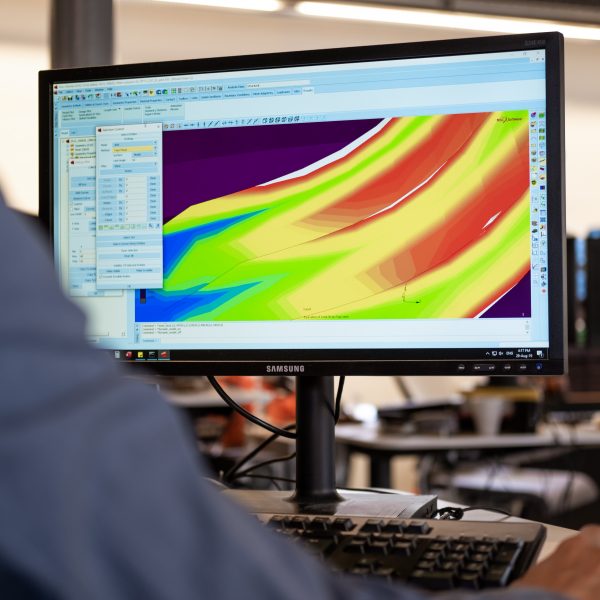
BPO uses Autodesk Moldflow Insight for injection-moulding simulations. This high-end software that covers all the aspects of the injection-moulding process, even including mould cooling.

Filling with two injection points: merging of flow fronts results in weld lines on opposite sides of the product.
IGS parts and products
IGS GeboJagema is a company that designs and manufactures moulds for the healthcare, optical and packaging industries. BPO has supported many of their projects with injection- moulding simulations. The results and recommendations were used by IGS to fine-tune part details and optimise their mould design. For example by determining the optimal injection point and adding venting to areas that would otherwise have an air trap or burn mark.

Filling of a reference cap compared with an optimised cap. The optimised geometry causes the air trap to end up at the bottom of the edge, where it is easier to create venting.
Laundry detergent bottles